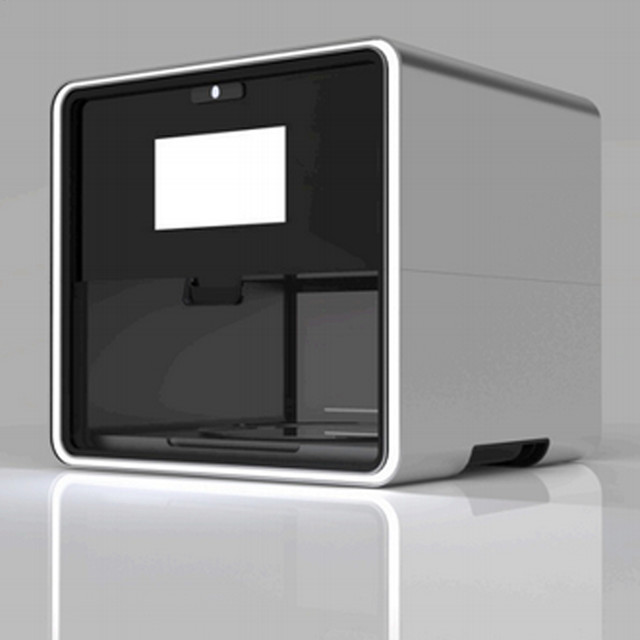
Some Barcelona based start-up Natural-Machines(aww we all love natural stuff.) wants to bring 3D Printing to home kitchens. Meet Foodini, prototype 3D Food Printer that can be used for printing different types of ingredients, such as chocolate and pasta. The creators of Foodini would love to see 3D food printer to be used in people homes not just fancy restaurants and make Savoy foods from ravioli to gnocchi. The printer prototype is only able to print one ingredient at a time(and as we know it in no time its gonna be multi ingredients printer), so making a hamburger for instance will take a few steps. BBC Click paid a visit to Natural Machines to see the Foodini in action. Take a look at the video below to learn more.
Monday, 30 December 2013
3D Food Printer Prototype
It's amazing what's been happening in 3d printer world first plastic things,models later we even can print body parts which is unbelievable and now food i guess future just keep's getting more awesome everyday.
Some Barcelona based start-up Natural-Machines(aww we all love natural stuff.) wants to bring 3D Printing to home kitchens. Meet Foodini, prototype 3D Food Printer that can be used for printing different types of ingredients, such as chocolate and pasta. The creators of Foodini would love to see 3D food printer to be used in people homes not just fancy restaurants and make Savoy foods from ravioli to gnocchi. The printer prototype is only able to print one ingredient at a time(and as we know it in no time its gonna be multi ingredients printer), so making a hamburger for instance will take a few steps. BBC Click paid a visit to Natural Machines to see the Foodini in action. Take a look at the video below to learn more.
3D Printer World Expo Contest Win 15$k
As the Gutenberg press of our time, the 3D printer unlocks humanity's
vast creative potential, enabling anyone to convert their artistic
vision into a 3D sculpted reality. Many believe with such incredible
capability that humanity is on the verge of its greatest Renaissance.
To celebrate this revelation, co-sponsors 3D Printer World and GROWit 3D invite artists to envision and create an abstract sculpture/3D printable design that symbolizes the essence of what a "Renaissance" is. Artists are free to explore any shape and form that visually articulates the meaning of this powerful word. Potential ideas for inspiration include rebirth, enlightenment, revolution, and golden age. Interpretations can be personal, historical, spiritual, or scientific.
More on the Contest Please Check: 3dprinterworld
To celebrate this revelation, co-sponsors 3D Printer World and GROWit 3D invite artists to envision and create an abstract sculpture/3D printable design that symbolizes the essence of what a "Renaissance" is. Artists are free to explore any shape and form that visually articulates the meaning of this powerful word. Potential ideas for inspiration include rebirth, enlightenment, revolution, and golden age. Interpretations can be personal, historical, spiritual, or scientific.
More on the Contest Please Check: 3dprinterworld
Printing Body Parts with 3D Printers
The use of 3D printing in the medical field seems all the fuss of late as every week a new story happens about a new invention that will revolutionize something. Just last week we featured a story about a 3D biopen that can be used by surgeons.
Looking at some of Seraph’s work, Lou Walcer, the director for the McGovern Family Center for Venture Development in the Life Sciences where the company is based, said “when we first encountered Seraph Robotics, they were proposing to do a lot of different things, including food printing, with their platform technology.” Since then, the team has turned its attention towards bio printing and have had several promising tests, including successfully printing anatomical simulators for surgical training.
At the moment, the company is selling 3D bio printers to research labs for $5,000 a pop. These printers can be customized to those labs needs with custom additions and modifications.
3D printer made out CD-ROM drives prints figures in Jelly
At a friend's birthday party, Jeroen Domburg behind SpriteMods realized he could use some food dye and a syringe to make very cool jello shots. By putting the needle at a certain position in the jello and releasing some of the dye, he could actually make 3d figures in the jelly.
A while ago, a friend of mine turned 25 and held a fairly big birthday party. One of the things he wanted to serve were jello shots: basically little shot glasses of jello with alcohol mixed in. The consistency and sweetness makes for a pretty interesting drink, and he wanted to make 70 or so shots, at least one for every guest. Of course, to test it all out, he had to make a sample batch.However his friend, who thought the idea was pretty neat, found the process of creating the figures by hand is not viable. So Domburg decided to use the components he already had at home to make a 3d printer that could print with food dye in jelly.
While inspecting the sample batch, I noticed the jello had small bubbles of air captured in them, at various heights. The jello was solid enough to keep them there: they wouldn't rise to the top of the shot glass at all. This gave me an idea: I ran upstairs and grabbed a syringe (I have a couple of them, they're pretty handy as flux dispensers etc) and put some green food dye in it. Now, by putting the needle at a certain position in the jello and releasing some of the dye, I could make 3d figures in the jelly.
Instead of using straight actuators or steppers with belts to get a precise straight movement, Domburg used parts collected from some old CD-ROM and DVD drives, such as the stepper motors, and put together them on a wood board. Three stepper motors were used to control the move of syringe needle in all three directions. One of the CD-ROM drive tray ejector was positioned near the syringe's plunger to push the liquid into the Jello.
Domburg then programmed a bunch of coordinates for the figures, and some logic to move the needle point around. Because of the parts used and its small size, the printer only needed around 10V of power to function, meaning you can power it using a laptop battery and it is pretty portable.
The last part is the ink. After a few tests, Domburg eventually got good effects with a mix of banana liquor, food coloring and some corn starch. "I put it in the microwave for a small while to get the corn starch to turn everything into something that's more like a gel than a liquid. With that, I had something I could make nice lines with." Check out below the two figures Domburg created on his 3D Jello Printer: a box and a spiral:
Things That Hold Back 3d Printing World
3D printing is the most practical and economical way of mass
prototype production. But creating a 3D model is not really as easy and simple as
everyone expects it to be. You don't only need to learn how to use the cad program but you also have to learn how to design a working model.
You also need to learn how to fix models by yourself to be able produce a
satisfactory resoult. It really takes a lot of time and skill and
trials to create a working cad model.
There are many 3D model libraries in the Internet that you can download for free. However, most of the cad models are either not moderated or incomplete and will not be able to produce satisfactory results. Moreover, you can’t really be sure that a downloaded model will work in tune with your 3D printing solution. Most 3D printing technology in the market requires a certain design technique for it to deliver good results. This is also why 9 times out of 10, a single model will not create a quality part of a different 3D printer.
Additive manufacturing or 3D Printing improved tremendously on reduction of material costs this year. But printing expenses are only a small drop in ocean of problems . Many 3D printers today are limited to material of choice which is plastic like ABS (Acrylonitrile Butadiene Styrene) and PLA (Polylactic Acid) to create products as needed. Such materials work just fine for small prototypes with no working parts. However, they are still too far weak to be employed to create working common household products. They can’t take a lot of pressure making the product to break apart completely.
3D prints are also in additional to that, different 3D printing technologies are using proprietary consumables which only works for a specific 3D printer. You still have to purchase a specific material for it to work in tune with your equipment. It is rather annoying but unfortunately, we can’t do anything about it until 3D Printing Companies decide to standardize the materials.
And lastly there many 3D printer types available in the market. Each type of printer has its own pluses and minuses. The main consumer-level 3D printers are the FDMs. These kind of 3D printers extrudes ABS or PLY plastic in a relatively safe container and the materials cools down pretty quickly to assume a shape,form or model. The print outputs are safe to touch right from a machine while leaving little mess.
That however, is not the same for many other types of 3D printers. For example, 3D printing solutions that use Resins as the main consumable can produce more detailed products. But they are much more expensive to run and they are messy. Powder-based printers are the most dangerous types and messy and is literally explosive-bomb. Another 3D printing solution either operate at high temperatures, produce horrible parts or leave an intolerable amount of unrecoverable waste.
There are many 3D model libraries in the Internet that you can download for free. However, most of the cad models are either not moderated or incomplete and will not be able to produce satisfactory results. Moreover, you can’t really be sure that a downloaded model will work in tune with your 3D printing solution. Most 3D printing technology in the market requires a certain design technique for it to deliver good results. This is also why 9 times out of 10, a single model will not create a quality part of a different 3D printer.
Additive manufacturing or 3D Printing improved tremendously on reduction of material costs this year. But printing expenses are only a small drop in ocean of problems . Many 3D printers today are limited to material of choice which is plastic like ABS (Acrylonitrile Butadiene Styrene) and PLA (Polylactic Acid) to create products as needed. Such materials work just fine for small prototypes with no working parts. However, they are still too far weak to be employed to create working common household products. They can’t take a lot of pressure making the product to break apart completely.
3D prints are also in additional to that, different 3D printing technologies are using proprietary consumables which only works for a specific 3D printer. You still have to purchase a specific material for it to work in tune with your equipment. It is rather annoying but unfortunately, we can’t do anything about it until 3D Printing Companies decide to standardize the materials.
And lastly there many 3D printer types available in the market. Each type of printer has its own pluses and minuses. The main consumer-level 3D printers are the FDMs. These kind of 3D printers extrudes ABS or PLY plastic in a relatively safe container and the materials cools down pretty quickly to assume a shape,form or model. The print outputs are safe to touch right from a machine while leaving little mess.
That however, is not the same for many other types of 3D printers. For example, 3D printing solutions that use Resins as the main consumable can produce more detailed products. But they are much more expensive to run and they are messy. Powder-based printers are the most dangerous types and messy and is literally explosive-bomb. Another 3D printing solution either operate at high temperatures, produce horrible parts or leave an intolerable amount of unrecoverable waste.
Subscribe to:
Comments (Atom)